Part 1. Chapter 5. Cook's Time-Table. Tables of Proportions, Weights and Measures
From Practical Cooking And Serving by Janet McKenzie Hill, 1919. Section 38 of 825.
In preparing a meal it is quite essential to know accurately the time required for cooking the different viands, otherwise one dish may become cold, while the cook is waiting for the completion of another that is to accompany it. With the aid of an oven thermometer, or heat indicator, one can by actual experience soon learn almost to a certainty the length of time required to bake most articles. This is especially true in case of bread, pastry, cake, puddings, and custards, the ingredients of which may be considered as known quantities. More or less doubt exists in regard to the length of time required for the cooking of animal and vegetable substances; for with these tenderness, one of the most important things aimed at in the cooking, will depend upon variable conditions, as, in animal substances, age and habits of life, and in vegetables upon age, soil, and season in which they are grown, and upon the length of time passed since they were gathered.
In the tables given below, the minimum and maximum times are given in which the article is to be cooked at a suitable temperature. When articles of same weight vary in thickness, the thicker will require the longer period. The time depends not so much upon weight as upon the extent of surface presented to the heat. For instance, a long thin fish will require ten or fifteen minutes less time in baking than a short, thick middle cut of salmon of the same weight. As an aid to best results in baking, an oven thermometer, or "heat indicator," is of great value. The heat indicator shows the temperature of the oven, but to secure and keep this temperature, the condition of the fire-box, when coal or wood is used, must be studied with care. The matter is much more simple when gas or electricity is the fuel. When a dish is ready for the oven, though the index points to the proper temperature for the cooking of that dish, if the fire be spent - the coal showing by a white line near the edges that it has lost its vitality - the temperature will fall rapidly, and the addition of coal will not help the matter before the article, be it cake, or some delicate confection, is utterly ruined. Then, too, if the fire be new and fierce, unless it be regulated with the nicest care, the heat is apt to become too severe. The indicator does not regulate the fire, but shows the condition of the oven as far as heat is concerned. But by judgment and experience the exact temperature for the baking of each dish can be determined, and the regulation of the fire to maintain this temperature be secured. The figure gives a general idea of an oven thermometer, or heat indicator.
For instance, when there is no fire in the range the hand points to 6.
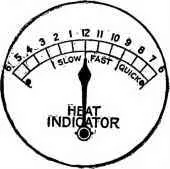
At the temperature suitable for putting bread into the oven the hand points to 12. After the first fifteen mintues the hand should move gradually backward halfway to three, where it should remain until the bread is baked. To sear over the outside of meat, or to cook wild ducks and small birds the hand should point to about 9. After the first half-hour roasts like beef and mutton should cook with the index in the vicinity of 12, back of it rather than beyond it. Custards and articles poached in water below the boiling point need a temperature indicated at about 2. With a little experience one can bake different varieties of cake in succession in an oven whose heat is gauged to fit each case to a nicety.
In this connection it may be noted that a coal fire is kept in good condition when it is so kept that it can be quickly regulated to meet the demands made upon it. Oftentimes, however, it is more economical, when a hot fire is wanted for a short time only, to keep the fire dormant, as it were, and use for the time being a gas or oil-range, and then transfer the article to the coal-range that has been kept at a moderate heat. But this is not always practicable.