Part 2. Chapter 20. Dessert Dishes
From Practical Cooking And Serving by Janet McKenzie Hill, 1919. Section 591 of 825.
Synopsis of Chapter
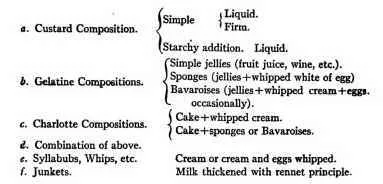
Recipe For Making Custards
Custards are compositions, in which lightly cooked milk and eggs predominate; in custard of the first quality nothing else save sugar, salt, and flavoring is added. In preparations of inferior quality starchy materials take the place of a part of the eggs.
Two Forms Of Custard
Custards are of two main characteristics - i.e., firm or liquid. Firm custards are cooked while standing undisturbed in hot water; liquid custards are stirred during the entire process of cooking, the dish holding the ingredients standing meanwhile in hot water; in both cases the heat required is lower than that of boiling water. Custard is properly cooked when the egg is "set" by the heat just enough to insure a smooth, tender, jelly-like consistency through out. A custard that curdles, or wheys, or is full of holes (either large or small), has been cooked at too high a temperature. A firm custard is cooked when, on touching the centre, it seems lightly set and somewhat firm. All custards become more solid on cooling.