Mutton And Lamb
From Practical Cooking And Serving by Janet McKenzie Hill, 1919. Section 161 of 825.
AVERAGE CHEMICAL COMPOSITION OF MEDIUM FAT MUTTON AND LAMB AS PURCHASED (ATWATER) | ||||||||||||
Mutton |
Refuse Per Cent. |
Water Per Cent. |
Protein NX 6.25 Per Cent. |
Fat Per Cent. |
Ash Per Cent. |
Fuel Val. per lb. Calories. | ||||||
|
Leg, hind |
18.4 |
51.2 |
15.1 |
14.7 |
.8 |
.900 | ||||||
|
Loin |
16.0 |
42.0 |
13.5 |
28.3 |
.7 |
1.445 | ||||||
|
Shoulder |
22.5 |
47.9 |
13.7 |
15.5 |
.7 |
.910 | ||||||
Lamb | ||||||||||||
|
Breast |
19.1 |
45.5 |
15.4 |
19.1 |
.8 |
1.090 | ||||||
|
Leg, hind |
13.4 |
47.3 |
15.8 |
23.7 |
.8 |
1.295 | ||||||
|
Loin |
14.8 |
45.3 |
16.0 |
24.1 |
.8 |
1.315 | ||||||
All kinds of meat when first slaughtered are tender, but sooa stiffen owing to the clotting of certain proteids in composition, which were liquid during life. After being kept, or, technically speaking, "hung" for some time, meat becomes more tender, due to the tearing-down processes of bacteria. Beef should hang in a dry cool place for at least three weeks, and mutton much longer. In England the Christmas "shoulder of mutton" is hung for six weeks, being rubbed over every few days with salt and vinegar. Mutton and lamb are often cut into "sides" in the same manner as beef, but occasionally, the first division is made to include the two forequarters in one piece and the hindquarters in the other.
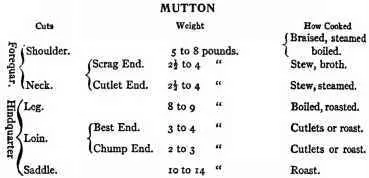
This division gives means for the cutting of a "saddle" of mutton or lamb. A sheep two or three years old, or even older, supplies the best mutton. Lamb is from a creature six to twelve weeks old, Mutton is a staple. Lamb appears in market as early as January, but is high in price even at Easter, when spring lamb with mint sauce and green peas are considered, time out of mind, the most recherche of Easter dinners. But lamb two months old is dear at any time, and dearer still are peas in April, which are grown in a hothouse. The flavor of neither the lamb nor the peas will, in general, compensate for the price; so a roast of mutton - saddle, crown, or leg - and new string beans, grown more easily than peas, will more frequently appear in evidence on this day.